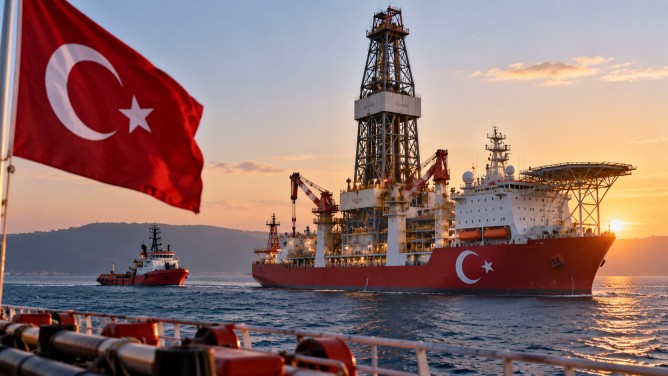
Türkiye is poised to embark on a new drilling venture aimed at extracting oil from the western Black Sea, marking a significant step in its ongoing efforts to bolster domestic oil and natural gas reserves. Energy Minister Alparslan Bayraktar highlighted the technical challenges of the upcoming drilling operation, noting that it could be a lengthy process. The ambitious plan fits within a broader strategy that includes conducting six exploratory wells across various sections of the Black Sea—western, central, and eastern—by 2026.
In recent years, Türkiye has significantly enhanced its offshore exploration capabilities. The country currently operates a fleet of six deep-water drilling vessels, several of which are actively engaged in exploration and development activities in the Black Sea. This expanded capability reflects Türkiye’s commitment to increasing its energy independence and boosting domestic production.
Türkiye has set its sights on increasing production from its Black Sea gas fields, aiming to double output by the end of the year. Following several discoveries since 2020, the estimated reserves in the Black Sea have reached approximately 785 billion cubic meters. At present, production stands at about 9.5 million cubic meters per day, which meets the natural gas needs of roughly 4 million households. By 2028, the government anticipates production will rise to between 16 and 17 billion cubic meters annually.
This push to expand domestic production is a crucial component of Türkiye’s broader strategy to lessen its reliance on imported energy. In addition to increasing natural gas output, the country is also expanding its LNG infrastructure and pipeline connections. These efforts are part of a larger initiative to position Türkiye as a key energy transit hub in the region. Moreover, the nation is exploring new routes that could facilitate the transport of gas from the Middle East to European markets.